Welcome to A Library Out of Air — a collective, free and accessible archiving project created out of the ether.
Our sonic past is full of mischievous and unruly radio spirits, podcasting experiments and audio inventions. How might we summon these sonic ancestors to unsettle the narrow sound of our present?
What lost futures might open up if we surface more of this medium’s memory?
Over the next year, we want to support a mass edit of Wikipedia — creating an ever-growing network of pages on radio programs, documentaries, series, dramas, podcasts, stations and formats that have transformed our audio imaginations over time.
Help make visible alternative histories, inspiring audio and remind yourself what brought you to this world in the first place!
Click HERE to access our sign-up form.
You can use the form simply to sign up to our quarterly newsletter, receiving glimpses of new Wikipedia pages and joyful audio rabbit holes to tumble into.
Or you can use it to share something you’d like to contribute - from the tiniest edit to creating a whole new page.
We are building a public spreadsheet that shows (anonymously or connected to your name if you’d prefer) what pages are currently being edited or created. This is so we can work as a community to support and build this web of information together.
Below, you’ll find more on why we think Wikipedia is the place to build this collective project + a simple guide on how we can build this archive together — from the smallest edit, to creating a whole new page.
An Evaporating Artform
Radio has a long history of vanishing into thin air.
Our imaginative past rarely resurfaces, the way cult classics and groundbreaking works do in music or cinema, visual art or literature.
Those artforms’ archives weave their history through the fabric of our lives - old films playing on the television, sculptures in public space, centuries of imaginations lingering on bookshop shelves and on gallery walls.
Most radio disappears in its moment of broadcast, lingering only in the memories of those who happened to tune in and hear it or those who accessed its short-lived online availability window. We live inside a forgetful medium. One where the context of what’s been possible - of radio and podcasting’s breadth and weirdness, its invention and imagination - can easily slip out of earshot.
If an artform can’t remember its own creative past, it’s at risk of allowing its future to be written by those who would shrink its creative scope or disregard the labour rights and skills of the people making the work.
Who needs a skilled artist in an artform that no one can prove ever really existed?
Why Wikipedia?
Wikipedia is the world’s leading information source.
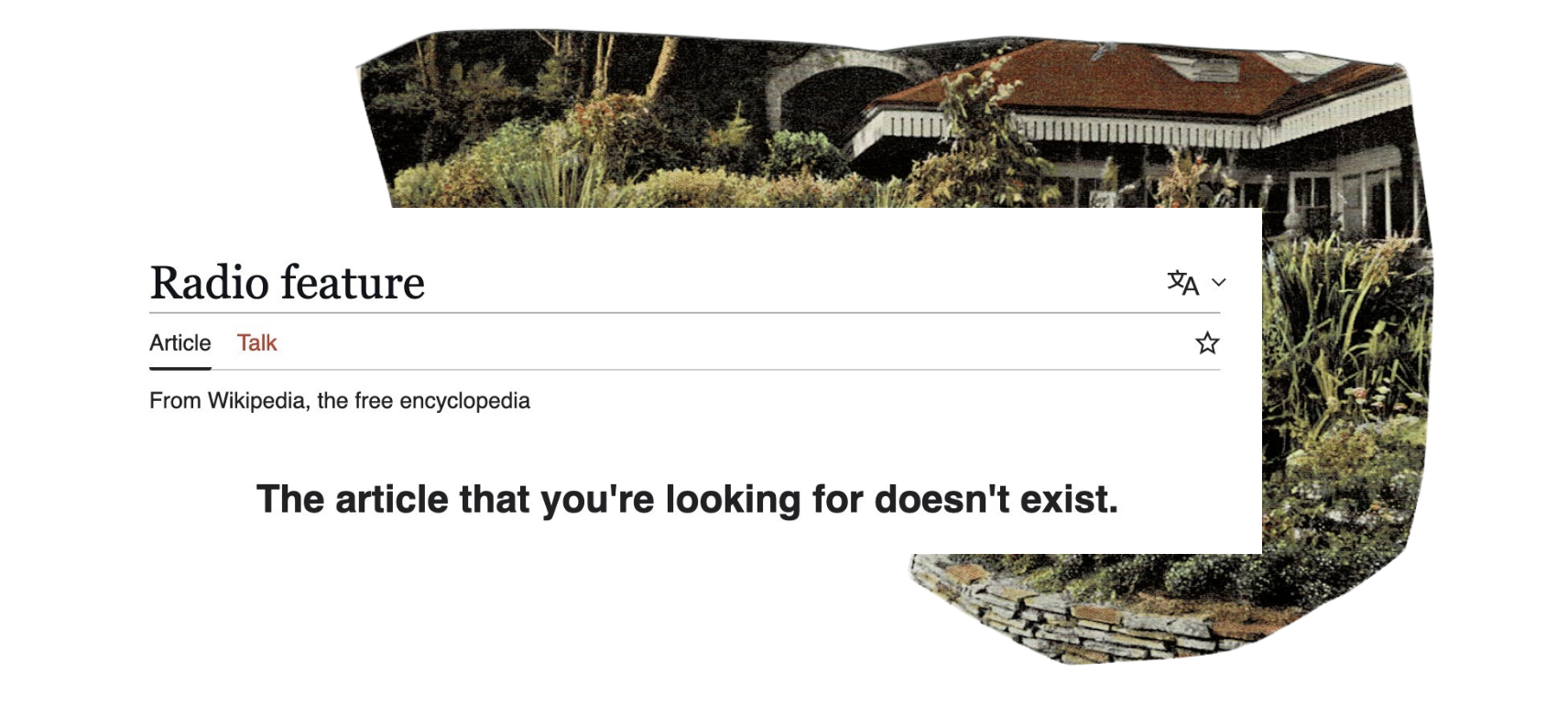
It shapes every search engine result and AI-query, in multiple languages, but has vanishingly little trace of radio and podcasting.
At the time of writing, the Radio Documentary page, for example, offers a bizarre and biased patchwork - a ‘history’ section that only mentions America, three random quotes, one paragraph describing a single program from India and then a list of feature makers, many of whom leave little other trace on Wikipedia beyond this single mention of their name.
This page is at the top of the search results if you google, “radio documentary”.
Our medium is constantly being reshaped by anxieties about its discoverability — podcasts contorting into cheap television so they function as good Instagram adverts, celebrity-led chat shows proliferating so they can tap into pre-existing fanbases…
Maybe, instead, we could consider an approach to serendipitous discovery that doesn’t obliterate all the things that brought us here in the first place — that celebrates sonic imaginations, the intimacy and possibilities of the medium.
If one person contributing a single edit can transform a search engine result - just think what a whole community of edits could do together?
Building the Library
Making an edit
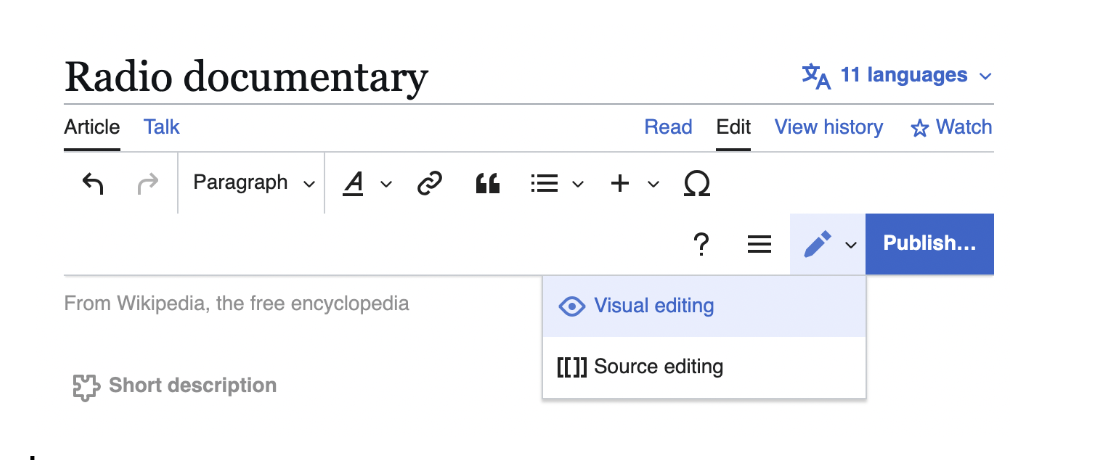
You don’t need an account to edit Wikipedia - visit the page you want to amend and hit the edit button at the top of the page.
Visual editing is the simplest way to amend a pre-existing article. Choose this option by clicking the pencil symbol next to ‘publish’. The page will then transform into an editable word document where you can easily add or delete words, sentences or whole paragraphs.
Use a neutral tone (Wikipedians call this NPOV — Neutral Point of View) and stick to verifiable facts - information rather than opinion.
Wikipedia encourages attributing any statements to a reliable, published secondary source - add citations where you can!
Sources can be academic journals, history books, news websites, places where this work has been written or talked about rather than the personal website of a maker or their LinkedIn page. To help, we’ve built a starter list of potential secondary sources at the bottom of this page.
When you’re done hit publish. You’ll then see a box that asks you to briefly explain what you’ve changed. Write a simple line or two to say why you’ve made this edit and then click publish changes. Your edit will immediately go live on the site.
Creating a new page
“Wikipedia is a work in progress: perfection is not required”, one of its instructional pages explains.
Start with stubs! You could begin by just creating what’s known as a stub (an article of 300 words or less) and sharing that page with us through our form.
This can help us draw attention to work you’d like other people to contribute to. What you write doesn’t need to be more than a handful of sentences, just the existence of the page will already be invaluable and help encourage others to contribute.
“Collaborative editing means that incomplete first drafts can evolve over time into excellent articles… one person may start an article with an overview of a subject or a few random facts. Another may help standardize the article's formatting or have additional facts and figures or a graphic to add. Yet another may bring better balance to the views represented in the article and perform fact-checking and sourcing…” — https://en.wikipedia.org/wiki/Wikipedia:Editing_policy
If your page references other programs, radio stations, artists, podcasts etc, it’s great practice to hyperlink to pre-existing Wikipedia articles on those subjects. This will help bolster the ‘notability’ of your page and also increase the chance of serendipitous discovery as people find themselves tumbling happily from one page to the next.
If you’re new to making a page we recommend Wikipedia’s Article Wizard - this will take you through the process step by step of creating a draft. Once your draft (long or short) is finished you can submit it to Wikipedia for review. If you’ve followed the guidance in the Article Wizard within a short period of time it should be published!
If you already have an account you can create a page even faster by searching for the subject on Wikipedia and following the link to create the page directly.
Things to Avoid
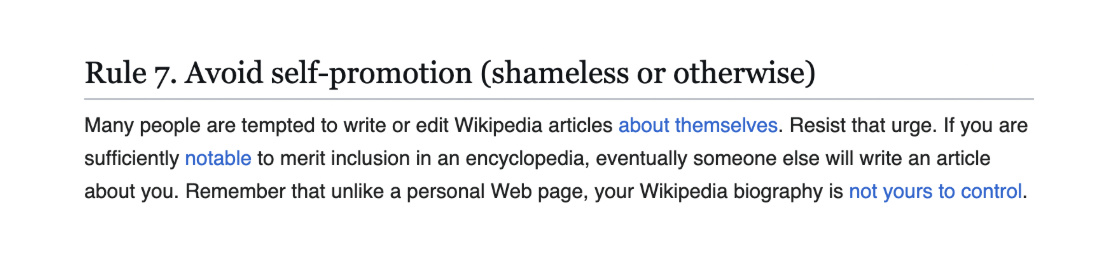
Avoid self-promotion or conflicts of interest.
Do not use AI to write for Wikipedia! Wikipedia has explicitly banned AI-generated content (with the exception of minor copy edits and translations). It’s also worth noting that AI has the capacity to ‘hallucinate’ and cite things that have never existed and to distance you from reliable, verifiable sources.
Where can I find reliable, independent secondary sources for audio?
Here are some of the websites that we’ve found helpful in the past. This is a non-exhaustive list but we hope it might contain new rabbit holes to tumble down…
NB your citations can (and should wherever possible!) include sound recordings, radio programs and podcasts.
If the audio is the subject of the article you can add listening links to an External Links section at the bottom or if it’s a secondary source (commenting on or talking about the history of a subject) then it can be a citation.
Transom https://transom.org/
BBC Genome
A vast archival project which shares Radio Times billings from across the BBC’s history
Continuous Wave
Julia Barton’s newsletter about the history of American Radio.
https://juliabarton.com/newsletter
Sound Fields
Bibliography of radio history sources might be particularly useful: https://www.soundfields.org/thriftingrefs
RadioDoc Review https://www.uowoajournals.org/rdr/
The Art of Radio by Donald McWhinnie
https://www.worldradiohistory.com/UK/UK-Books/The-Art-of-Radio-McWhinnie-1959.pdf
Have other good source ideas? Share them with us and we’ll add them to our newsletter and source lists.
Who are the librarians of air?
Ideally, we all are!
This project was instigated by Eleanor McDowall (Falling Tree / Weird Noise) and Kalli Anderson (Sound Fields), but our hope is the library will take on a life of its own, spreading far and wide, following the interests and tastes and audio obsessions of whoever joins in. We plan to send out periodic newsletters sharing some of the new additions and unearthed sounds, but our greatest hope is that many of us all over the world start making a habit of adding to this online archive of our field.
If you want to join us, start by filling out this short form.
Questions? Email editors@soundfields.org